
TONGUES
What Scripture Says (And What It Doesn't Say)

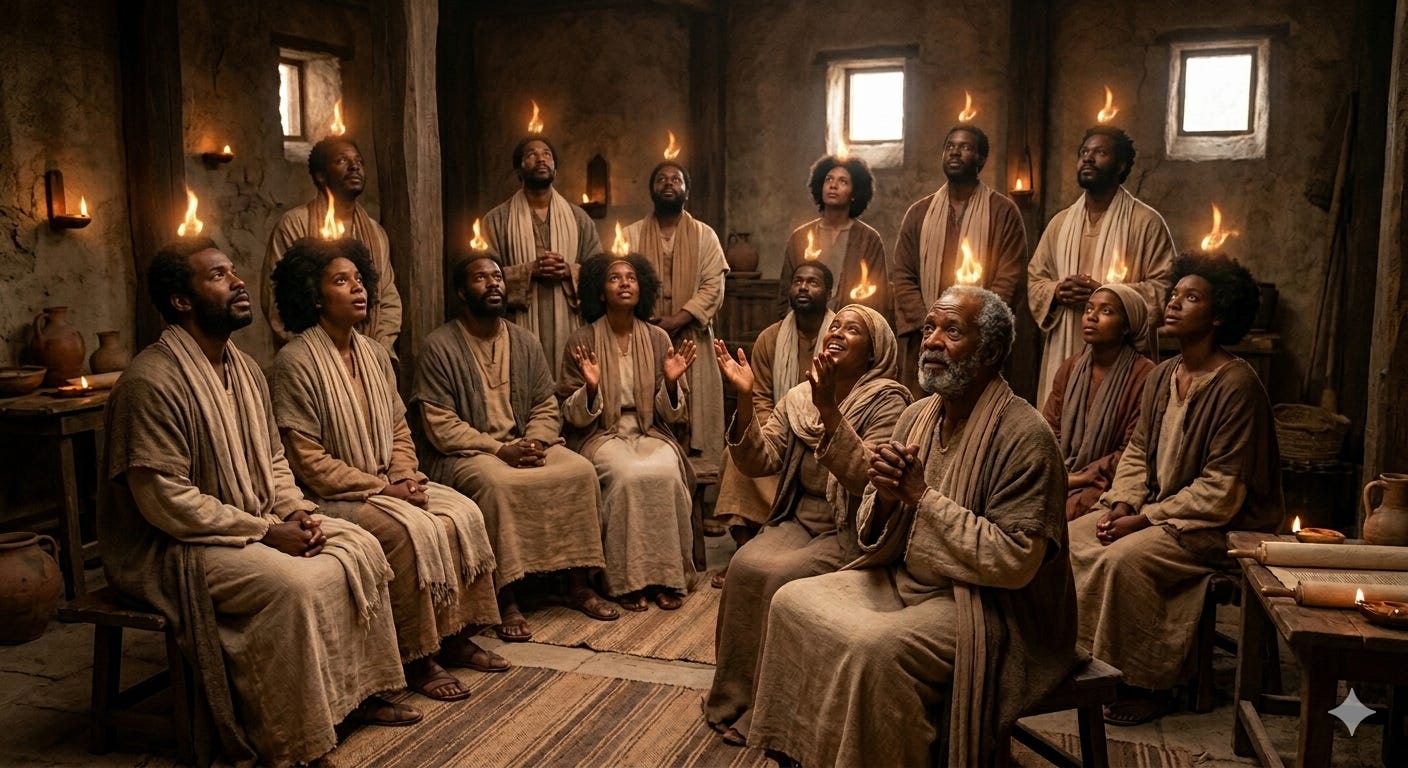
Some of you have asked me to write about praying in tongues. It is a topic that divides Christians, and for good reason. Let me be clear about what this essay is and what it is not. It is not a defense of tongues ceasing or continuing. What I want to do is read the Biblical text with care, without the the assumptions our christian movements have made on our behalf. The reason this matters is that most of the debates about tongues, on both sides of the aisle, have generated considerably more heat than light, because people are defending positions rather than READING SCRIPTURE. If we cannot first agree on what the Biblical text actually says, then every argument that follows is irrelevant.
What Acts Tells Us
The account in Acts 2 is the most famous and the most clearly described. On the day of Pentecost, the disciples are filled with the Holy Spirit and begin speaking in other tongues. Luke is precise in his vocabulary (the word he uses is dialektos, meaning a dialect or native language, not mystical syllables). The crowd gathered in Jerusalem hears the disciples declaring the mighty works of God in their own languages: Parthians, Medes and Elamites; residents of Mesopotamia, Judea and Cappadocia, Pontus and Asia,Phrygia and Pamphylia, Egypt and the parts of Libya near Cyrene; visitors from Rome (both Jews and converts to Judaism); Cretans and Arabs. These are real human languages spoken by people who have never learned them. The crowd hears, is bewildered, and the event opens the door for Peter’s sermon and three thousand people are converted. Whatever else one wishes to argue about tongues, the tongues in Acts 2 are identifiable human languages serving a distinct communicative function.
The same pattern reappears in Acts 10, when the Spirit falls on Cornelius and his household, and in Acts 19, when Paul encounters the disciples of John in Ephesus who had not yet heard about the Holy Spirit. In both cases, tongues accompany significant boundary crossing moments in the expansion of the gospel, first to Gentiles, then to disciples of John who were converted to Christ. What Luke does not say, however, is that speaking in tongues is the required evidence that a believer has received the Spirit. He records it happening but does not prescribe it as the standard test for all believers at all times. That distinction is the difference between what the Bible says and what many teachers have built entire doctrinal systems on.
What 1 Corinthians Tells Us, and Why Paul Is Correcting Rather Than Celebrating
Paul’s most extensive treatment of tongues is a correction. The Corinthian church had become infatuated with the gift. Tongues had become a status symbol, a sign of spiritual superiority, the centrepiece of their gatherings. Paul does not deny the gift, and he is not writing to celebrate what the Corinthians are doing. His entire argument in 1 Corinthians 14 is structured around a single evaluative question: is this building anyone up?
It is worth noting what Paul means when he speaks of prophecy in this chapter. He is not primarily speaking about predicting the future. In Paul’s usage across his letters, and particularly in 1 Corinthians 14, prophecy in the congregational setting refers to Spirit given speech that declares, exhorts, or reveals something from God for the strengthening of the church. Gordon Fee, in his commentary on 1 Corinthians, describes it as intelligible speech that builds up, encourages, and comforts the gathered body, grounded in the Spirit’s activity rather than the speaker’s preparation alone. When Paul says the person who prophesies brings words of encouragement, consolation, or instruction, that is the register he is working in: preaching and exhortation that carries spiritual authority, not the foretelling of future events.
With that in mind, Paul’s argument in 1 Corinthians 14 becomes clearer. Prophecy, understood as Spirit-given proclamation for the church, is more valuable in the assembly than tongues, not because tongues is worthless, but because the person who prophesies builds up the church, while the person who speaks in a tongue, unless there is interpretation, builds up only himself (v. 4). Paul is not condemning the gift but he is locating it in its proper place: it has genuine value, but its value is primarily experienced by the individual who exercises it, not by the congregation that witnesses it.
Then comes his most striking statement: “I thank God that I speak in tongues more than all of you. Nevertheless, in church I would rather speak five words with my mind in order to instruct others than ten thousand words in a tongue” (vv. 18-19). Paul speaks in tongues privately more than any of them; he is not hostile to the gift, and he is not writing as someone unfamiliar with it. What he is opposing is the misuse of tongues in corporate worship, where it becomes a performance rather than a service. The Corinthians had turned a gift meant to serve the body into a display designed to elevate the self. This is precisely the pattern we see repeated today, where people rattle away in tongues mindlessly in corporate worship, completely disregarding the guidance Scripture outlines on how to use the gift.
His rhetorical question in 12:30 settles the matter of universality when he asks: “Do all speak in tongues?” The Greek construction expects a negative answer. No, not all do. The Spirit distributes gifts as He wills (12:11), not as the individual demands or as the tradition insists. Tongues is therefore not the standard evidence of Spirit baptism. The New Testament simply does not teach that. Paul is equally clear, however, that tongues in the assembly is subject to regulation, not elimination. If anyone speaks in a tongue, let there be two or three, and let someone interpret (14:27). If there is no interpreter, the speaker should remain silent in the gathering (14:28). Notice also that he would not have instituted rules about interpretation if tongues were going to cease, because you do not build a regulatory structure for something you expect to disappear. He ends the chapter with a command that is frequently quoted by one side while being ignored by the other: “Do not forbid speaking in tongues” (14:39). The gift is real and the order is non-negotiable. As far as Paul is concerned, he does not let you have one without the other.
The Strengths and Weaknesses of Each Camp
The Cessationist Position
The cessationist position, which holds that tongues along with other sign gifts ceased with the apostolic age, makes a serious historical and theological argument. Its strongest claim is that the supernatural gifts in the New Testament appear in specific contexts tied to the founding of the church and the authentication of the apostolic message. John MacArthur, in Strange Fire, presses this argument insisting that tongues in 1 Corinthians, properly read, are the same as the tongues in Acts, namely real human languages, and that this observation undermines the contemporary charismatic practice of unintelligible speech that bears no resemblance to any human language. First Corinthians 13:8-12 is the most significant Biblical text on this question, and cessationists note that the word “cease”(pauo in the Greek) is explicit. When Paul says “tongues will cease,” he is making a statement about the temporary nature of the gift. The question is not whether they will cease but when. Cessationists also point to the relative silence of the church fathers on tongues beyond the early apostolic period. Justin Martyr, writing in the mid-second century, listed seven spiritual gifts without mentioning tongues (Dialogue with Trypho, chs. 87-88). John Chrysostom, writing in the fourth century, spoke of tongues in the past tense, describing their cessation as an acknowledged historical reality (Homilies on First Corinthians, Homily 29).
The serious weakness of cessationism, however, is that the New Testament nowhere explicitly states that the gifts will end with the apostolic age. MacArthur’s critics are correct on this point. Craig Keener, responding to Strange Fire, notes that MacArthur’s reading of church history is selective: Irenaeus, Origen, and Tertullian all report tongues and other gifts continuing well beyond the apostolic period, and Augustine, whom cessationists sometimes cite, later changed his position after personally witnessing miracles, going on to document in The City of God cases of healing from blindness, cancer, and paralysis, as well as four raisings from the dead. Keener also presses the point that MacArthur abandons the task of discernment by condemning all charismatic gifts wholesale, a position Paul himself nowhere takes. Paul’s response to Corinthian abuse is correction and regulation, not abolition. Cessationism, in its more rigid forms, goes further than Paul ever does. Furthermore, if tongues were to cease before Christ’s return, Paul’s command not to forbid speaking in tongues becomes difficult to understand. Instructions are given for what will continue, not for what is about to disappear. The architecture of 1 Corinthians 14, with its detailed rules for when tongues may be exercised, how many may speak, and what must accompany it, makes better sense if Paul expected the gift to continue and needed to govern its use.
The Continuationist Position
The continuationist position, which holds that all gifts including tongues continue today, has the stronger exegetical case on several significant fronts. Sam Storms, in Understanding Spiritual Gifts, argues that the cessationist case depends on reading tongues as primarily a revelatory gift. But when you read Paul’s own description of what tongues involves, it is not revelation but prayer, praise, and gratitude directed toward God (14:14-17). In verse 6, Paul actually distinguishes tongues from revelation, preferring revelation over tongues in the assembly precisely because revelation communicates to others. Storms also addresses the argument that tongues served as a sign to unbelieving Jews and therefore became obsolete after the destruction of Jerusalem in 70 AD. His response is that, even if tongues served that function in Acts, Paul in 1 Corinthians 14:4 speaks of tongues edifying the individual in private prayer, and in 12:7 he includes tongues among the gifts given for the common good of the body. A gift cannot be reduced to one function and then declared obsolete simply because that one function has passed. That is reading your own assumptions into the text rather than letting the text speak for itself. In verse 12:11, Paul states that the Spirit distributes gifts as He wills, with no expiration clause attached to that statement.
The “last days” framework of Acts 2:17, where Peter quotes Joel’s prophecy that in the last days God will pour out His Spirit on all flesh, applies to the entire period between Pentecost and Christ’s return. The era of Spirit outpouring in which tongues, prophecy, and dreams were promised is the same era in which we currently live. Any interpretation that circumvents Paul’s command to be eager to prophesy and not to forbid speaking in tongues, as Keener argues, is theologically inconsistent with the New Testament’s own eschatological framework. Yet the continuationist world has a serious failure of practice that needs to be called out. The popular charismatic handling of tongues has inverted almost everything Paul taught. Paul places tongues last in his list of gifts (12:28). He surrounds it with more restrictions than any other gift in the New Testament. He argues that its corporate value depends entirely on interpretation being present. He asks rhetorically whether all speak in tongues and expects a resounding no. In many places, tongues have become a performance, a badge of belonging, or a tool of spiritual pressure. Some believers are made to feel inferior because they do not speak in tongues, while others are applauded simply because they can produce vocal manifestations. That is a serious distortion of Scripture. Paul never presents tongues as a badge of superiority. He places them under the authority of love, order, and edification. If tongues are truly from the Spirit, they will not be showy, will not produce pride, confusion, or competition.
Unpacking 1 Corinthians 14: Paul’s Actual Argument
Because this chapter is so frequently mined for single verses rather than read as a continuous argument, it deserves to be treated as a whole.
Paul’s concern from verse 1 to verse 40 is singular: the church must be built up. Every spiritual gift, including tongues, is evaluated against that standard. Tongues without interpretation fails that standard in a corporate setting because it communicates nothing intelligible to the hearer. Paul uses three analogies to press this point: a flute or harp playing indistinct notes, a bugle giving an unclear signal before battle, and a foreigner speaking a language you do not understand. In each case, the problem is not the sound itself but the absence of intelligible meaning. Sound without meaning cannot build up. This is precisely why interpretation is not optional when tongues is exercised in the assembly. Interpreted tongues becomes functionally equivalent to prophecy (v. 5), able to instruct, encourage, and strengthen the body. Without interpretation, the gift remains self-directed, and the congregation receives nothing. Paul also makes a distinction in verse 15 that often goes unnoticed: “I will pray with my spirit, but I will also pray with my mind; I will sing with my spirit, but I will also sing with my mind,” affirming both modes of prayer where neither is superior to the other. The person who prays in tongues privately is not more spiritual than the person who prays in their native language. Paul is simply describing the full range of his own prayer life.
His practical instructions are very specific: two or three may speak in tongues in a gathering, each in turn, with interpretation required. If there is no interpreter present, the tongue speaker must be silent in the gathering. These are not suggestions but apostolic commands with theological grounding. Paul does not accommodate disorder on the grounds that the Spirit is moving; his argument is that God is not a God of disorder but of peace (v. 33).
The closing command, “do not forbid speaking in tongues, but let all things be done decently and in order” (vv. 39-40), must be read as a complete statement. You cannot cite the first half to justify an unregulated free-for-all in corporate worship, and you cannot cite the second half to suppress or shame the gift. Paul insists on both, and a church that honours only one half of his command has not yet fully obeyed Scripture.
The Sovereign Will of the Spirit
One dimension of this conversation that rarely receives the attention it deserves is the sovereignty of the Spirit in the distribution of gifts. In 1 Corinthians 12:11, Paul writes that the Spirit distributes gifts “to each one individually as He wills.” The phrasing is clear that it is not as the believer desires, not as the tradition demands, and not as the spiritual climate of a particular movement has normalised. The Spirit decides who receives what gift and when. This means that praying in tongues cannot be an expectation that one individual places on another. It cannot be a milestone that a congregation sets for spiritual progress. The moment a community begins to treat tongues as a gift that every believer must seek and receive, it has stepped outside Paul’s teaching and into a system that domesticates the Spirit. The Spirit is not a resource to be unlocked by desire or technique but He is a person who acts according to His own will. This also means that the person who does not speak in tongues is not spiritually deficient. Paul’s rhetorical question, “Do all speak in tongues?” (12:30), is not a gentle suggestion that perhaps some believers have more growing to do. It is a theological statement about how the body works: different members receive different gifts, and none is therefore superior to another. The absence of tongues in a believer’s experience may simply mean the Spirit has given them other gifts.
Where I Land
After reading the text and attending to the arguments on both sides, I find the following to be what Scripture actually teaches as I see it.
The gift of tongues is present, Paul affirms it, exercises it personally, regulates it, and forbids its suppression. The gift of tongues should not be despised, but it must be governed Biblically. If the Spirit gives it, receive it with humility. If He does not, do not fake it or force it. If tongues are spoken in church, let there be interpretation. If there is no interpretation, let there be silence. And above all, let love remain the highest mark of Christian maturity. Tongues may be part of the Christian experience, but they are never a substitute for character, holiness, and obedience to God’s Word.
Bibliography
Fee, Gordon D. The First Epistle to the Corinthians. New International Commentary on the New Testament. Grand Rapids: Eerdmans, 1987.
Fee, Gordon D. God’s Empowering Presence: The Holy Spirit in the Letters of Paul. Peabody: Hendrickson, 1994.
Justin Martyr. Dialogue with Trypho. In Ante-Nicene Fathers, vol. 1. Edited by Alexander Roberts and James Donaldson. Peabody: Hendrickson, 1994.
Augustine of Hippo. The City of God. Translated by Henry Bettenson. London: Penguin Classics, 2003.
Keener, Craig S. Spirit Hermeneutics: Reading Scripture in Light of Pentecost. Grand Rapids: Eerdmans, 2016.
Keener, Craig S. “A Review of John MacArthur’s Strange Fire.” Pneuma Review,November 15, 2013.
MacArthur, John. Strange Fire: The Danger of Offending the Holy Spirit with Counterfeit Worship. Nashville: Thomas Nelson, 2013.
Storms, Sam. Understanding Spiritual Gifts: A Comprehensive Guide. Grand Rapids: Zondervan, 2020.
Tertullian. A Treatise on the Soul. In Ante-Nicene Fathers, vol. 3. Edited by Alexander Roberts and James Donaldson. Peabody: Hendrickson, 1994.
Irenaeus of Lyon. Against Heresies. In Ante-Nicene Fathers, vol. 1. Edited by Alexander Roberts and James Donaldson. Peabody: Hendrickson, 1994.
Origen. Against Celsus. In Ante-Nicene Fathers, vol. 4. Edited by Alexander Roberts and James Donaldson. Peabody: Hendrickson, 1994.
Chrysostom, John. Homilies on First Corinthians. In Nicene and Post-Nicene Fathers, First Series, vol. 12. Edited by Philip Schaff. Peabody: Hendrickson, 1994.
I would love to hear your perspective in the comments. Have you experienced tongues? Are you skeptical? Where do you land on this?
If you found this useful, it is because we started with the Biblical text. That is what Undiluted is committed to. Subscribe to stay in these conversations.
i appreciate how throughly you explained this. the concept of speaking in tongues is something that has become rampant in a lot of charismatic & Pentecostal churches & i find that a pastor random breaking into tongues invokes a reaction from the congregation that they aren't aware is emotional. many in the charismatic world attend church with the expectation that an encounter with the Holy Spirit will bring about certain miracles they desperately seek. So when a church leader suddenly breaks into speaking in tongues, they start praising ('even with noone explaining the sudden bout of tongues)
This is a sober view of the relevant texts. Even though I end up on a different conclusion, your process is so commendable in its commitment to exegetical priority that I heartily commend this article.
There are a number of things the New Testament instructs without a necessary expectation of their continuation throughout coming history, e.g. greeting one another with a holy kiss. It is possible for Paul to regulate a practice present in the church at the time of his writing but which will eventually cease.
In 1st Corinthians, he also deals with food offered to literal idols and head-coverings versus head shaving. He deals with real issues the Corinthians were facing. He does not expect that those issues will face all churches throughout all of history, but he expects that the principles he teaches as he addresses the first century specifics of that particular church in Corinth will carry over to all churches everywhere, forever.
Again, thanks! This article is well-researched and well-written. Keep at it. You’re great at it. 💪🏾💪🏾